
Tough reality time: While most (if not all) writers dream of being full-time, work-from-home writers at some point, most of us are not able to do this. It sucks, I know, and I’m so sorry to say it.
This sad fact means that most of us have to balance our writing career with another “real” job. Because writers have to eat after all. I currently hold a full-time job, where I work 40 hours a week. And it is exhausting on its own.
So, how do we do we balance exhausting full-time work with our passion of writing?
A lot of writing advice out there demands writing every day, but for someone working full-time, that isn’t always feasible and it can put unnecessary stress on you – and we all know how stress is the enemy of creativity.
This is what I suggest (and do myself):
Write when you have time.
It’s definitely good practice to write as often as you can (think of the old adage “practice makes perfect”). Every day may not be doable, but setting aside a few minutes during a lunch break or a few hours on a day off should be.
Write when the inspiration strikes.
Forcing yourself to write when you are uninspired can feel like pushing a boulder uphill. So, when inspiration strikes (and we all know how fickle the Muses can be), grab the nearest piece of paper, sticky note, or napkin and jot it down.
The worst thing is when you think you’ll remember that great idea, only to promptly forget it by the time you sit down to work on it.
Set reasonable goals for yourself and your schedule.
As ambitious as it is to want to write 5,000 words in one day, it might not be a feasible goal to set for yourself. Instead, set more tangible goals like to write one scene, the opening or closing paragraph of your story, a short story, a poem, or 500 words in your work-in-progress.
Speaking of schedules, it never hurts to create one… and stick to it (I see you).
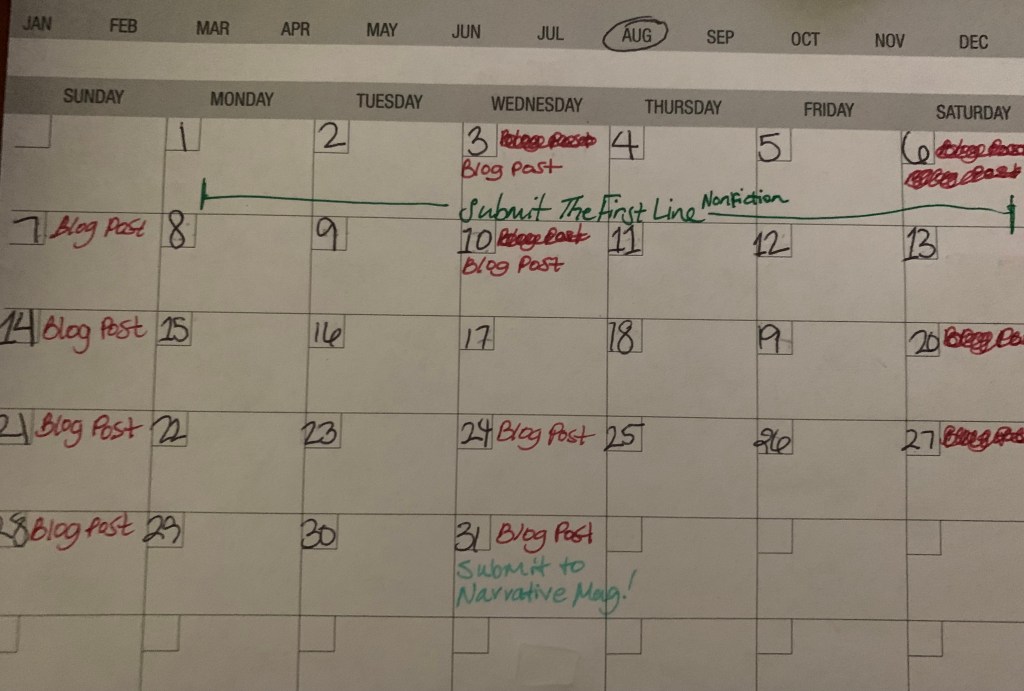
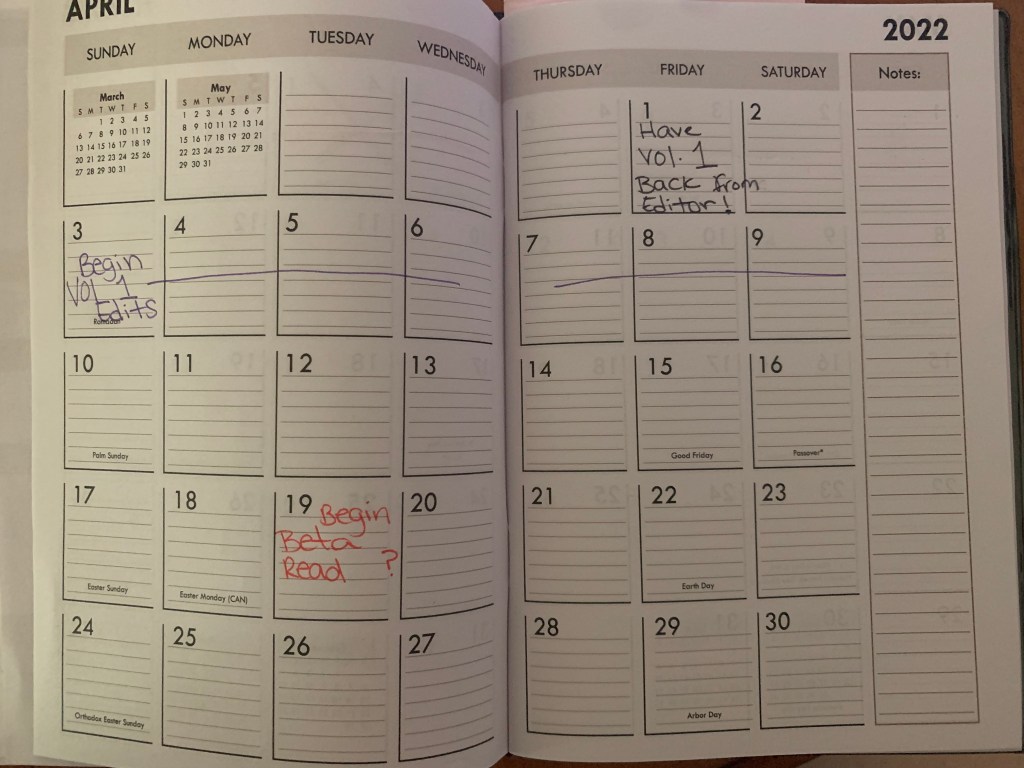
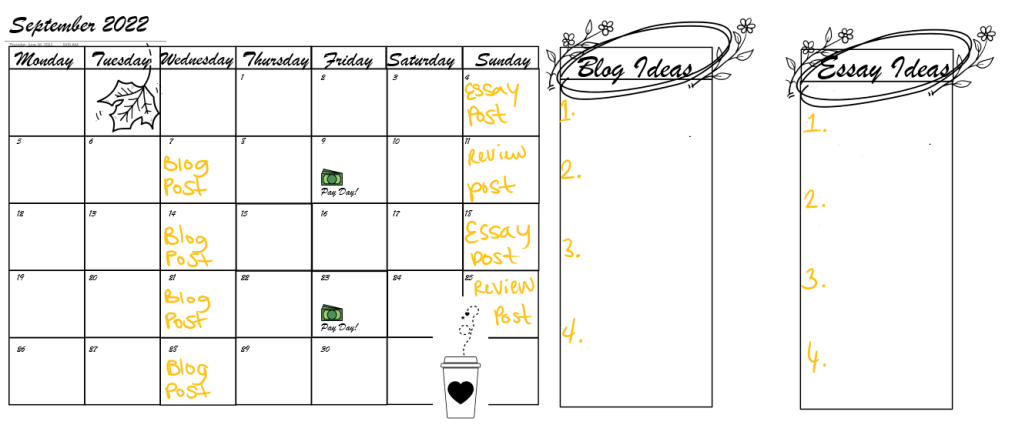
I have created three separate calendars for myself – one for blogging, one for freelance writing and contests, and one for my novel series Salem Winters Paranormal Problem Solver (which you can find out more about on the My Books page and will be published on October 31st, 2022 – shameless plug!)
I try to stick to my calendars as best as I can. Obviously, it is important to be flexible because things will inevitably pop up and change your plans.
So far, my blog schedule has been the one I stick to most rigidly (posting every Wednesday and Sunday), but the first day I set up my freelance calendar, something came up that changed all of my plans. C’est la vie.
Prioritize!
When you have a full-time job, that is usually your priority (gotta make that cash). And in this job, you probably have to prioritize which tasks get done first (or at all). The same goes for writing. You must prioritize which pieces you want to work on.
I usually base my priorities on deadlines first (the sooner it is due, the more important it is); then anything that doesn’t have a set deadline is prioritized by personal interest, personal goals, or the time it will take to complete it.
For example, if I have four projects: a contest submission due in one week, a paid freelance article submission with no set due date, a work-in-progress novel, and a blog post – my priority list might look like this:
- Contest submission due in one week – for obvious reasons, this one is first. If it is due in one week, GET IT DONE!
- Blog Post – Since I follow a strict blog schedule, blog posts should be prioritized if no other deadlines are coming up.
- Work-in-Progress Novel – While I think 3 and 4 could be interchangeable, I would prioritize my WIP because I am passionate about it and have publishing goals.
- Freelance article with no set due date – Again, I could comfortably flip 3 and 4, but if the article has no due date, I would be inclined to work on it last when I have little else to work on.
I do feel like it is important to mention that it is okay to bounce around and work on multiple projects at the same time. The point of prioritizing however is to stay accountable for the ones that need to be done first.
Obviously, the things I have suggested in this post are the things that work for me. It is important to find ways that make sense for you to balance work with art. It’s also very important to stick with these habits – after all, they say it takes 21 days to form a habit!
I hope this helps, and good luck!
Read More

One Sentence Story #77
One Sentence Story #77
Strangers
A short creative piece.
Meme Monday
It’s Meme Monday, everyone!
Something went wrong. Please refresh the page and/or try again.
 Savannah Watson
Leave a comment